
Introduction
Interior Decoration Tips Mintpaldecor is far beyond acquiring good-looking furniture and following the current interior style fashion. Good interiors merge color, proportion, lighting, texture, storage capacity, and functionality together to make the room not only visually appealing but also comfortable to live in.
The Interior Decoration Tips Mintpaldecor may be useful for the homeowners to develop their decorating strategy. Rather than filling the room with all kinds of accessories, it would be reasonable to start with analyzing the room’s function, measuring the space, making a focal point, and picking up the compatible pieces.
Whether it is a living room, a bedroom, a dining room, or even an apartment to rent, a smart decorating strategy may work wonders without the need to renovate everything.
Start With the Function of the Room
Before deciding on paint colorings or furnishings, determine what the room needs to accomplish. A dwelling room designed for family gatherings would require a distinctive arrangement from a proper sitting location, at the same time as a bed room have to prioritize relaxation instead of visible clutter.
consider how people flow via the room, where they clearly sit down, and which sports happen there. This simple starting stage prevents common mistakes such as blocking walkways, buying oversized furnishings, or creating appealing areas which can be uncomfortable to apply.
Interior Decoration Tips Mintpaldecor: Create a Simple Room Brief
Write down three things before shopping:
- The primary purpose of the room
- The furniture or features that must remain
- The environment you like to create
Such as, a small living room might require comfortable seating, concealed storage, and enough open floor space for movement. That brief becomes a real filter for every aesthetic choice.
Measure Before Buying Furniture
One of the most essential Decoration tips for decoradyard is also one of the most neglected: measure up
When you’re buying a room, write down all the measurements, including how high the ceiling is.Also, note where the doors and windows are placed.Make sure to include the location of radiators, wardrobes, and any other built-in furniture.Don’t forget to mention any stairs or narrow passages where you’ll need to move big furniture around.
Think About Furniture Proportion
The furniture must be in accordance with the scale of the room. Big pieces of furniture can make a small room look too big for them, while small pieces of furniture will not look appropriate in a big room.
A great way to achieve this would be to draw a layout plan of the room first, noting the size of the furniture before anything is actually purchased. Even cardboard templates or painter’s tape can be used to depict furniture.
Choose a Consistent Color Palette for Interior Decoration Tips Mintpaldecor
Color is among the major techniques of linking the different aspects of a room through visual means. Rather than selecting each color separately, select an appropriate color scheme which will include dominant colors, subordinate colors, and accents.
While developing a calm interior design, one can use neutral walls together with wood, fabrics, and accents which are soft in nature. In order to add life to the interior design, neutral background can be used with bright pieces of art work, cushion covers, carpets, and decoration pieces.
Use the 60-30-10 Principle Carefully
However, it is also advisable to consider the possibility of using the well-known ratio 60-30-10 without necessarily sticking to it rigidly. 60% of the space can be taken by the dominant color, 30% by the supporting one, and 10% by the accent one. It does not matter what precise figures you take into account; it is important just not to overcrowd the space visually.
Make Lighting Part of the Design
Lighting is often treated as an afterthought, but it can dramatically change how colors, textures, and furniture appear.
An appropriately designed space would usually require more than one level:
- Ambient lighting to illuminate the space
- Task lighting for reading or working
- Accent lighting for paintings, structural features, or decoration
Daylight needs to be taken into account when placing the furniture or choosing colors. Watch the room during different hours of the day.
Select Bulbs for the Atmosphere
Color temperature will determine the atmosphere that the room will have. The warm color lighting will make the room more relaxing, while the cool color lighting will energize the room.
Avoid using similar lighting for all rooms, but use different lighting according to activities and types of rooms.
Build Layers With Texture
Even though a room might have a limited number of colors, this does not mean that it lacks richness because of the availability of different types of textures such as wood, stones, glass, metals, and even fabrics.
This is where many Decoradyard tips become useful: decorating should not depend entirely on adding more objects. Texture can provide visual interest without overcrowding the room.
Combine Textures Without Losing Balance for Interior Decoration Tips Mintpaldecor
Try pairing materials with contrasting characteristics, such as:
- A soft rug with a wooden floor
- Linen curtains with a painted wall
- A textured cushion with a smooth sofa
- Natural wood with metal accents
- Matte surfaces with carefully placed glass
The objective is variation with coordination rather than random combinations.
Create a Strong Focal Point
Every room benefits from a visual anchor. This can be anything from a fire place, artwork, architectural element, lighting statement, head board or even furniture placed carefully.
A focal point serves as something for the eyes to rest upon and helps in arranging the room.
Avoid Too Many Statement Pieces
Putting several exciting elements in the same space can make them fight for attention.If there’s a big piece of art already drawing people in, smaller items should usually help it stand out instead of trying to be the main focus.
This idea is especially useful in open spaces where different areas of the room share the same look.
Arrange Furniture Around Conversation and Movement for Interior Decoration Tips Mintpaldecor
Furniture must be arranged in a manner that makes it smooth to transport around obviously.make certain there are clean and at ease areas among large pieces of furniture, and don’t region whatever in a manner that blocks doors, windows, or common paths.
In a living room, it is higher to position seating so human beings can face each other in preference to simply setting them against every wall.
In bigger rooms, the use of an area rug or a console can assist create a clean section or place.
Use Rugs to Define Areas
Rugs can link pieces of furniture and define spaces even without walls.
An ideal rug must be big enough for the pieces of furniture to be related to it. A small rug can make nice furniture seem out of place.
Use Mirrors Strategically
Mirrors can boost the notion of depth and mirror available mildly. They’re mainly useful in slender hallways, compact dwelling rooms, and regions with restrained natural illumination.
but, placement subjects. A mirror has to replicate something well worth seeing, which includes herbal mild, art work, greenery, or an attractive architectural characteristic.
Decorate Walls With Intention
Walls don’t have to be necessarily decorated. Empty spaces play an essential role in the composition of the interior and help create calmness in the room.
If it is possible to decorate walls, then one should use artwork, photos, bookcases, mirrors, wall moldings, or a statement item instead of many different items on the walls.
Create an Artwork Arrangement
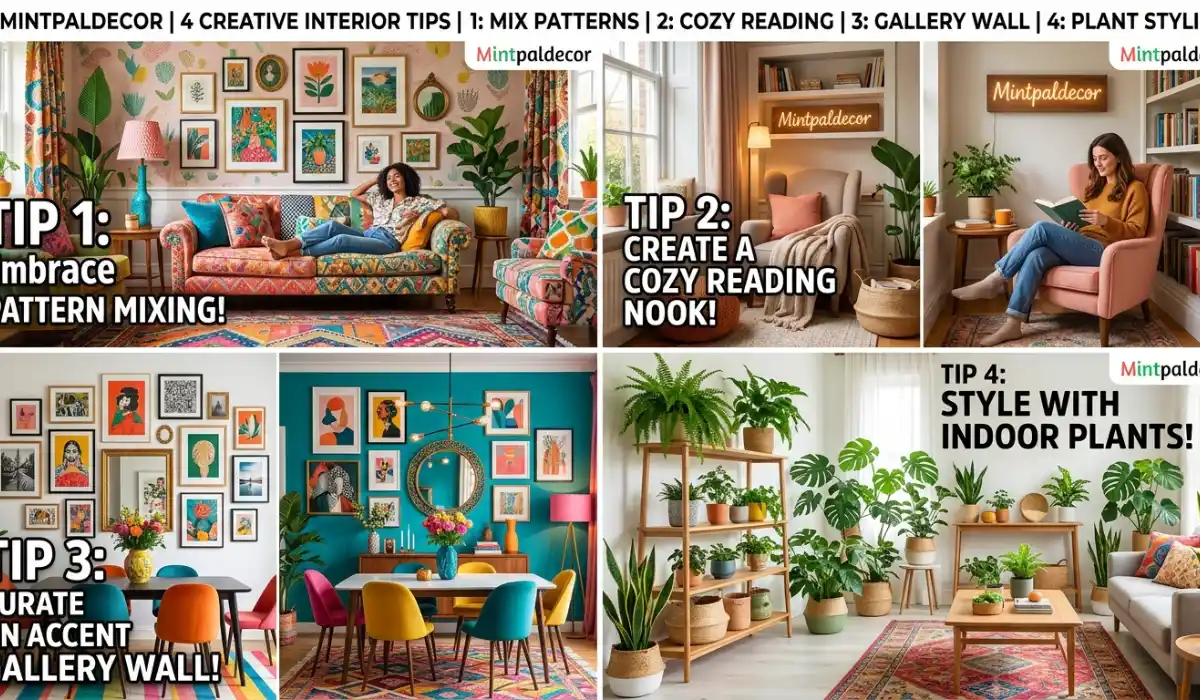
Make sure there is a connection in appearance between the artwork for a gallery wall. This could mean using frames that match, using colors that repeat, or sticking to the same theme.
Arrange your gallery on the ground to check spacing before drilling any holes into the wall.
Add Plants and Natural Materials
The addition of plants creates color and organic forms to the interior and also makes for softer interiors which tend to have hard surfaces like glass, metal, and tiles.
The use of natural materials like wood, rattan, stone, cotton, linen, and jute would provide a warm feeling to the interior design, especially when all other elements in the palette are kept subdued.
Make Small Rooms Feel Larger
Small spaces demand editing as opposed to shrinking down every single piece used for decoration.
Select pieces that match the size of the space, keep some floor space visible, store things properly, and use reflective surfaces and mirrors.
Use Vertical Space
When space on the floor is at a minimum, then walls should be considered for storage and displays. High shelves, vertically hung artwork, lights, and curtains can direct one’s attention to the ceiling.
This will give the impression that thought has gone into the room without losing much valuable floor space.
Improve Storage Before Adding More Decor
One of the most practical Tips decoradyard is to solve clutter before attempting to improve aesthetics.
Objects used for decoration cannot solve problems of disorganization. When surfaces are always filled with various chargers, papers, toys, clothes, and other odds and ends, then the room will never be truly finished.
Select storage systems based on what must actually be stored. Closed storage hides visual clutter, whereas open storage works best for objects that need to be shown off.
Choose Curtains According to the Room
The choice of window coverings affects the aesthetics and functionality of the area. It may help to manage privacy, light levels, insulation, and even height perception of the room.
The windows can usually be hung from above the height of the window frame in order to increase the perceived height of the room.
Use Accessories in Groups
Decorative accessories appear to have been placed on purpose when they are grouped in sets and not placed haphazardly.
Use different heights, shapes, and textures while keeping a connection between the colors or materials used. For instance, you may use a pottery vase, a framed picture, and another object that is textured in a single design on the console.
Follow the Editing Rule
Once all the decorations have been done, it could also be worthwhile to get rid of some items from the setting.
Anything which does not contribute to the function, texture, color, memory, and balance of the room should possibly be stripped out.
Bring Personality Into the Interior Decoration Tips Mintpaldecor
A well-finished room should have some connection to its occupants. Certain books, traveling items, pictures of the family, hobbies, paintings, and collections would make the home more genuine.
Avoid copying a showcase. One can use present tendencies for inspiration, but the decisions themselves should be made according to one’s taste.
Create Contrast Without Creating Chaos
Contrast gives the interior its energy. This is possible through the use of color, size, texture, form, and even materials, not relying only on the vividness of the colors.
For example, a white sofa may match a dark wooden table, and smooth cabinets will work well together with wove objects. Repeating the same element that contrasts with the interior makes everything uniform.
Consider Maintenance and Durability
Beauty is not the only concern since the surface needs to be functional as well. Prior to choosing expensive finish materials or delicate fabrics, take into account maintenance, kids and pets, light, moisture, and the use of the area.
High traffic areas require tough finish materials that are easily maintained. Not taking into consideration the issue of maintenance can cause difficulties eventually.
Common Interior Decoration Tips Mintpaldecor Mistakes to Avoid
Some interiors feel unfinished because they lack enough visual structure, while others feel uncomfortable because too many elements compete for attention.
Avoid these common problems:
- Buying furniture before measuring the room
- Using too many unrelated colors
- Depending on a single ceiling light
- Choosing rugs that are too small
- Pushing every piece of furniture against the wall
- Filling every empty surface with accessories
- Ignoring storage requirements
- Copying trends without considering functionality
The solution is not necessarily to spend more money. Better planning usually produces a stronger result.
Budget-Friendly Interior Decoration Tips Mintpaldecor
Refreshing a home does not always require replacing major furniture. Small, targeted changes can alter the appearance of a room significantly.
Start with the elements that occupy the largest visual areas, such as wall color, curtains, rugs, lighting, and furniture arrangement. Then introduce smaller accessories after the main composition is working.
High-Impact Changes on a Limited Budget
| Improvement | Visual impact | Typical planning priority |
| Furniture rearrangement | High | First |
| Decluttering and storage | High | First |
| Lighting updates | High | High |
| Wall color | High | High |
| Curtains and textiles | Medium–High | Medium |
| Artwork | Medium | Medium |
| Small accessories | Medium | Last |
This approach prevents money from being spent on decorative details before the basic layout and atmosphere are established.
A Practical Decorating Sequence
A logical sequence will definitely simplify the whole procedure.
First, it is necessary to measure the space and define its purpose. Then the color scheme and overall placement of furniture must be decided upon, followed by planning of lighting, carpets, curtains, and storage facilities.
Small decorative items must only be considered after all these issues have been sorted out.
How to Combine Modern and Timeless Design
The home does not have to be totally modern to be considered modern. It would be better to work on timeless elements and add modernity through objects that could be replaced easily.
Architecture with neutral finish, good furniture, natural materials, and good proportions would have resulted in longevity. The fashionable colors and accessories could have been introduced by means of cushioning, art work, lighting, or any other small object.
Make Open-Plan Spaces Feel Organized
Open plan interiors can be visually confusing as several activities take place in one room.
You can use rugs, lighting, furniture layout, shelving, and variations in colors to separate areas. However, the materials used need to have some common elements that tie the whole room together.
Use Symmetry and Asymmetry Intentionally
Symmetry can help achieve formality and harmony, particularly around bed, fireplace, or console settings. Asymmetric designs can be more informal and contemporary.
Neither design has an advantage over the other. Use whichever design is appropriate depending on the kind of character you wish to portray.
A Simple Final Check Before You Finish
Stand at the entrance and look at the room as a whole. Then examine it from the main seating position and from the paths people use most often.
Ask whether the room has a clear focal point, sufficient lighting, comfortable movement, balanced colors, useful storage, and enough empty space. If one element feels too dominant, adjust it before buying anything else.
FAQs
What are the most important interior decoration principles?
The most important principles include proportion, balance, color harmony, lighting, texture, functionality, and visual hierarchy. These work together to make a room attractive and comfortable.
How can I decorate my home without spending too much?
Start with furniture placement, decluttering, lighting, and textiles before buying expensive decorative pieces. Reusing existing furniture in a new arrangement can also produce a significant visual improvement.
How many colors should an interior use?
There is no universal number, but a controlled palette is usually easier to coordinate. Choose a dominant color, a supporting tone, and a small number of accent shades.
How can I make a small room look bigger?
Maintain clear floor space, use appropriately scaled furniture, maximize natural light, and consider mirrors or reflective surfaces. Vertical storage can also help preserve floor area.
Should every room have the same decorating style?
Not necessarily. Rooms can have their own character while sharing connecting elements such as flooring, wood tones, colors, or materials to create continuity throughout the home.
What is the biggest interior decorating mistake?
A common mistake is decorating before planning the room’s function and proportions. Buying attractive pieces individually does not guarantee that they will work together in the actual space.
Conclusion
The best interior decoration tips mintpaldecor are not about following every trend or filling a home with expensive accessories. They are about understanding how space, proportion, color, lighting, texture, storage, and personal style work together.
Start with function, measure carefully, establish a coherent palette, and build the room in layers. By making deliberate choices and editing unnecessary elements, you can create an interior that looks refined while remaining practical, comfortable, and genuinely suited to everyday life.